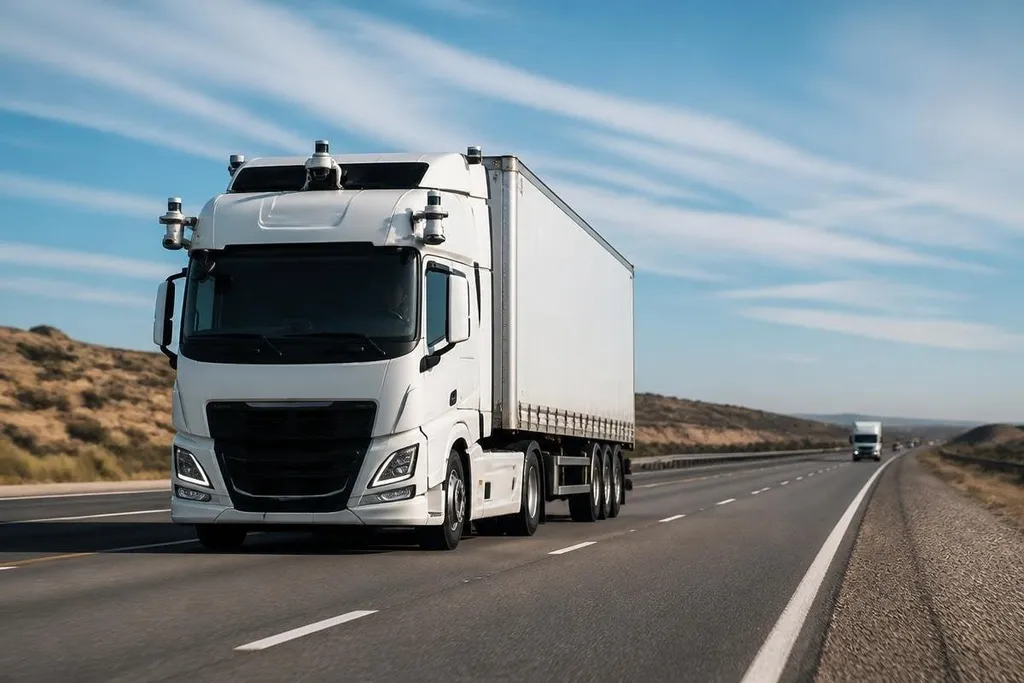
A self-driving truck has to move freight for hours, repeat the route, and stop safely when the road breaks the plan. That puts the global race on proof from real routes, real weather, and real costs.
- Highway driving is easier to automate than loading yards or city streets.
- Remote operators still matter when the truck meets a case its software cannot handle.
- Fleet buyers need cost per mile, service data, and clear safety records.
The hard part starts after the highway exit
A truck can follow lane lines at steady speed with cameras, radar, and LiDAR. LiDAR measures distance with laser pulses, giving the software a 3D view of nearby vehicles, road edges, and objects.
That work changes at a depot. The truck may need to reverse toward a trailer, wait for a worker, pass through a gate, or find a safe place after a sensor fault. Each step adds more people, tighter spaces, and more ways for a normal day to become an unusual one.
Highway routes give developers a controlled first job. Long stretches have fewer pedestrians, fewer traffic lights, and clearer lane markings. The remaining problem is repetition: the truck must handle thousands of similar miles without turning a rare case into a serious incident.
The truck needs a backup plan
Autonomy does not mean the truck handles every situation alone. A remote operator may review a blocked lane, a police direction, or a road closure and send the truck a new path.
That person cannot drive every truck by video. Network delay, poor camera views, and limited attention put a boundary around remote help. The software still has to detect the problem, slow down, reach a safe state, and ask for help in time.
The same rule applies to hardware faults. A truck needs braking, steering, power, and sensor plans that keep it safe after one part stops working. Fleet owners will ask for the failure record, the repair process, and the time needed to return a truck to service.
Repair time belongs in the cost per mile, alongside fuel, insurance, labor, and service. A report from Robot24 can tie those costs to the truck, route, test date, and failure record, so fleet owners can see whether autonomy cuts the bill or moves it into repairs.
The business test is cost per mile
A driver is one cost in a freight operation.
The full bill also includes fuel, tires, maintenance, insurance, dispatch, idle time, and the truck itself. An autonomous system adds sensors, computing hardware, software fees, remote support, and specialist repairs.
The numbers only work if the truck can run enough hours to cover those added costs. A vehicle that stops often for sensor cleaning, software checks, or remote review may save less than its sales pitch suggests.
Driver shortages can push carriers to test autonomy, yet a pilot still needs a route with steady freight and safe places to stop. A system built for long highway runs may fit a hub-to-hub lane while failing to suit local deliveries.
The race also has a public cost. A crash, a blocked road, or a failure to explain what the truck saw can slow approval for an entire fleet. That makes logged safety data more useful than a single record-setting trip.
What fleet buyers should ask for
Before signing a trial agreement, check the operating details behind the truck’s stated capability.
- Route limits: Which roads, speeds, weather conditions, and times of day are covered?
- Human backup: How many trucks can one remote operator supervise, and what can they command?
- Failure handling: Where does the truck stop after a sensor, computer, brake, or network fault?
- Fleet data: Can you see disengagements, safety stops, repairs, and miles from normal service?
- Cost terms: Which hardware, software, support, insurance, and maintenance costs sit with you?
- Expansion plan: What must change before the truck moves from one route to a larger fleet?
These questions separate a route-ready system from a research vehicle. They also give a carrier a way to compare suppliers without relying on the same demo footage.
I'd wait for published route data and repair figures before calling any autonomous truck ready for broad freight work.
The next useful number is not the longest unmanned trip. It is the cost per loaded mile after a full year of ordinary service.